Skip to content

Mequinenza's river heritage

The llaüt.
Memory
afloat.

Timber, coal and current. The river cargo boat that connected Mequinenza's mines with life along the Ebro.

Step aboard
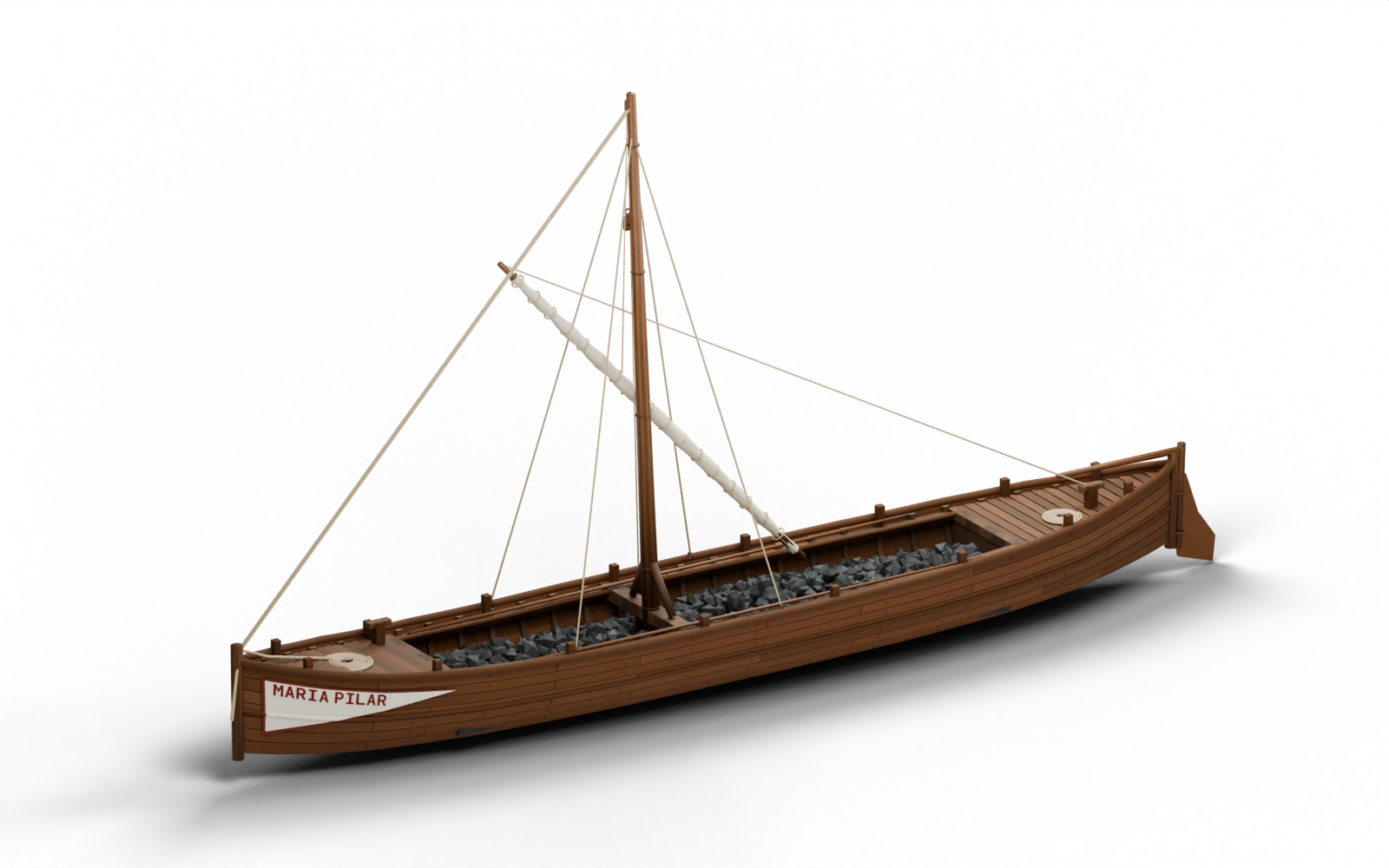
MARIA PILAR · A study of an Ebro river boatMARIA PILAR study model: a dark wooden llaüt with name panels at the bow, an open hold, a mast and a furled sail.
Interpretative digital reconstructionFurled sail · Overview

A river. A trade. A whole world.

Discover its history
01 / THE LLAÜT

Before it was a picture,
it was a working boat.

In Mequinenza, the llaüt — also known as a llagut— was part of the coal industry. These boats carried lignite from the mines down the Ebro towards places such as Fayón or Tortosa. The Natural History Museum of the University of Zaragoza documents this connection between mining and river transport, in collaboration with the Museums of Mequinenza. [1]

Its silhouette reveals its purpose: a long, shallow hull and a large central space for cargo. The photographs help us understand its form; the written sources shed light on the work it was built to do.

llaüt the boatllaguter the boatman's tradesirga the towlinelignite the coal of the basin
02 / EXPLORE

A llaüt within reach.

Turn it around, look into the hold and discover how it is built. The sail remains furled.

View of the llaüt model before starting the 3D exploration.

The model loads when you open it.

Study model · Not an exact replica

Two ways to look at the hold

Drag to rotate · Scroll or pinch to zoomHow it was reconstructed ↗

The labels follow the parts as you turn the boat. Select a label to learn what a part does; change the view to discover more.

THE LANGUAGE OF THE LLAÜT

Every part,
a word from the river.

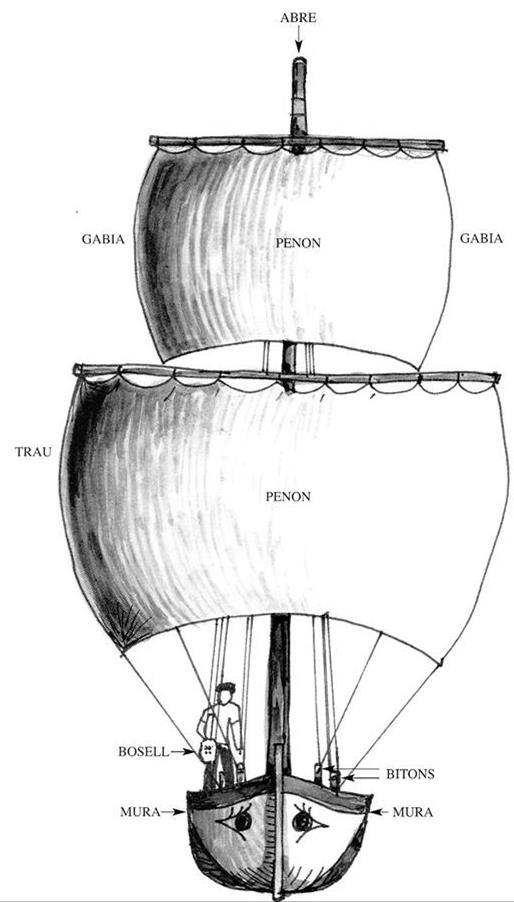
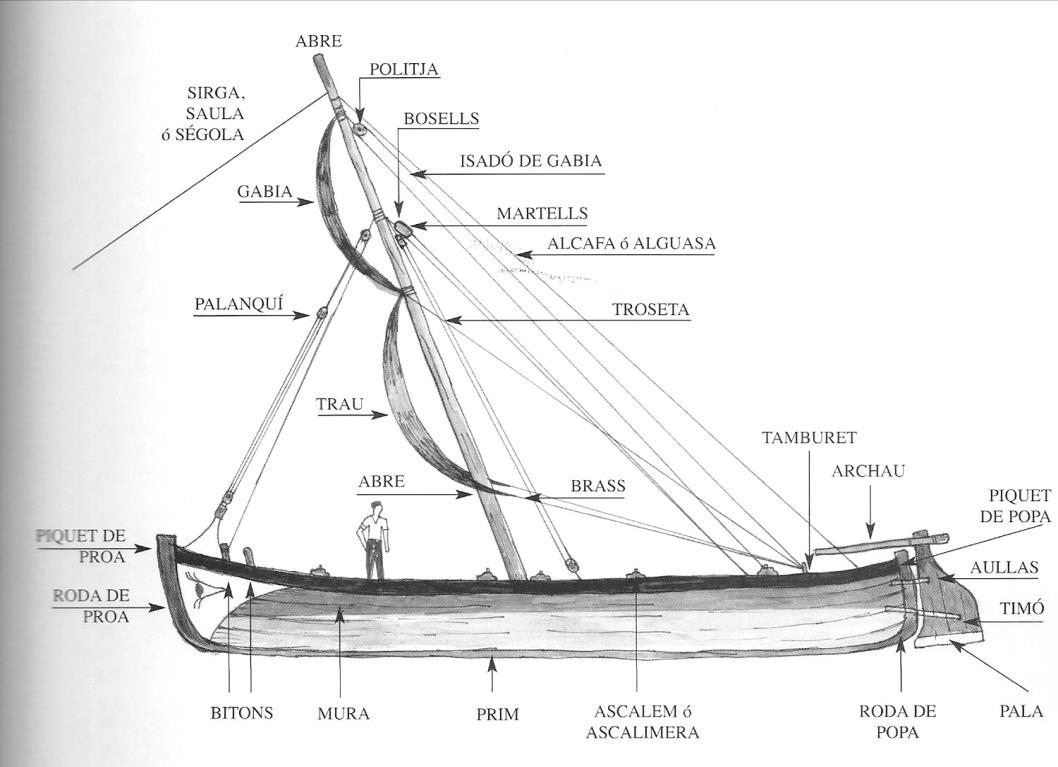
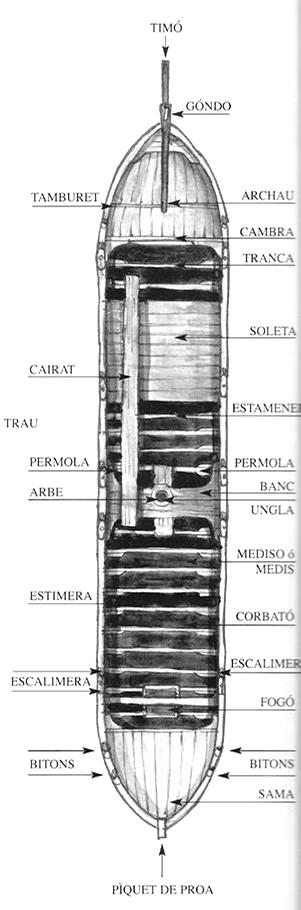
Three drawings to help you read the boat: its profile, the deck seen from above and the rig seen from the front. We retain the names on the drawings and explain their functions.

Side drawing of a llaüt with labels for the hull, rudder, mast, ropes and furled sails.
Bow on the left · Stern on the right
Select the drawing to enlarge it and read the labels.

01 / REFERENCE DRAWING

In profile

The hull, the towline and the parts used to steer the boat.

Stem
The curved timber that closes the hull at the bow. [7]
Sternpost
The timber that closes the hull at the stern. [7]
Rudder · timó
The movable part at the stern used to change direction. [7]
Rudder blade
The broad part of the rudder that acts on the water. [12]
Tiller · arjau
The lever used to move the rudder. [7]
Towline
A rope used to pull the boat from the riverbank. [9]
Selected drawing: The profile.

Read the drawings with care. These explanatory illustrations have no dimensions: they help identify the parts, but cannot be used to measure the boat. The drawing with sails set explains the rig; the 3D model keeps its sail furled.

Spellings, variants and labels awaiting verification +

The spellings on the drawings are retained. The accompanying vocabulary uses standard forms: for example, ARCHAU is explained as arjau and ABRE as arbre.

The plan places SAMA at the front and CAMBRA at the back. This arrangement agrees with Moret's correction concerning sarna/sama and cambra.

The profile groups ASCALEM and ASCALIMERA under a single label. Here, the thole pin and its support are distinguished.

The SOLETA arrow and several cropped labels on the plan need to be checked against the original edition. They are not translated as securely identified parts.

PALANQUÍ, ISADÓ DE GABIA, TROSETA, BRASS, ALCAFA ó ALGUASA and MARTELLS can be read on the drawing; their precise functions still need to be verified.

Three drawings supplied during this consultation. Their author and publication have yet to be identified. Vocabulary checked against Hèctor Moret and ‘Paraules de riu’. [7] [9] [12]

03 / THE COAL'S JOURNEY

The river was the road.
The return was another task.

River transport diagramMequinenza, Fayón, Flix and Tortosa connected by the Ebro. A railway connection at Fayón. Diagram not to scale. MequinenzaMINES AND LANDING PLACES FayónRAILWAY CONNECTION Flix Tortosa EBRO

Illustrative diagram, not to scale. It does not reproduce the historical riverbank.

DOWNSTREAM · WITH THE CURRENT

From mine to landing place. From river to railway.

The llaüts carried lignite to distribution points. Fayón was a crucial connection: a substantial share of the coal continued from there by rail towards Barcelona and Zaragoza. Other river destinations included the industries of Flix and the lower Ebro.

Source: historical research on navigation on the Ebro [4]
  1. 01
    The mines

    Lignite reaches the landing places.

  2. 02
    The llaüt

    The journey makes use of the current.

  3. 03
    The destination

    Transfer to the railway or delivery to industry.

THE EFFORT OF THE RETURN

Upstream
by towline.

The sirga was the rope used to pull the boat from the riverbank. Mequinenza Town Council describes this return journey after unloading the coal, mainly at Fayón station. [2]

The MNACTEC magazine links the introduction of animal towing by the Sociedad Electroquímica de Flix to demand during the First World War. [3]

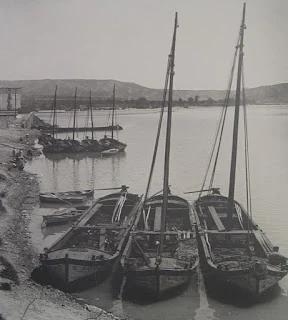
Historical photograph of several river boats moored along the bank, with their masts raised.
Moored boats · Photograph supplied by the project author.
Photographer, place and date have yet to be identified.
LIFE ABOARD AND ON THE RIVERBANK

The boat also embodied
the knowledge of its people.

01

Patró

The skipper was in charge of the llaüt and worked the rudder. Knowledge of the river was part of the trade. [7]

02

Peons

The crewmen helped with loading and unloading, rowed when needed and took part in towing. Their tasks depended on the journey. [7]

03

Matxero

The animal handler led the draught animal that pulled the boat upstream from the bank. [7]

04

Calafat

The boatbuilder built and repaired boats, sealing the hull's seams to keep out water. Also known as a mestre d’aixa. [9]

04 / READING THE TRACES

There was no single type of llaüt.
There are many ways to remember it.

A scale model, a preserved boat, photographs of working life. Each image offers a different clue. Their differences are also part of the story.

01 / The hull revealed

The name ‘Cardenal’ is legible. The raised bow, planking and open interior can be seen; the perspective does not reveal an exact scale.

02 / The furled rig

A reference for the mast, ropes and position of the canvas, with the sail furled.

03 / Memory in miniature

The ‘Octogesa’ scale model helps us understand the whole boat. A scale model is no substitute for the plans of an original vessel.

View the other references 3 photographs +
Profile and relationship between hull, mast and rudder.
Arrangement of holds and masts on several boats.
A historical photograph with sails, included for context. The model keeps them furled.

The six images come from the attachments to this consultation. Visible inscriptions allow names to be recognised, but do not verify authorship, date, location or rights of public reproduction.

05 / THE RIVER THROUGH TIME

From everyday work
to enduring heritage.

Mid-19th century

A mining basin

Lignite mining began, eventually giving fresh impetus to river transport in Mequinenza. [10]

1892

Fayón connects river and railway

The opening of the railway station shortened the coal boats' journeys by providing a transfer point. [3]

1914–1918

The demand for coal

The First World War intensified mining in Mequinenza and the transport of lignite along the Ebro. [10]

1941–1943

Maintaining the towpath

Work was carried out on the towpath between Tortosa and Mequinenza to make difficult stretches easier to pass. [4]

Late 1960s

The end of an era

Improvements in overland transport and the construction of reservoirs contributed to the disappearance of traditional commercial river navigation. [11]

2007–2009

Preserving Cardenal

The Government of Aragón documents the restoration of this llaüt, found years earlier in Miravet. It is a surviving example, not a universal measure of the type. [5]

06 / THE RECONSTRUCTION

What we see.
What we interpret.

This model brings together features visible in the six photographs. It is a 3D study reconstruction with editable geometry, not a photogrammetric model or a certified replica of Cardenal or Octogesa.

The working scale was guided by the published dimensions of Cardenal: 18.5 metres in length and 3 metres in beam. The exact hull shape, thicknesses, construction details and rig are not based on a measured survey. [5]

The amount of coal shown in the viewer is illustrative. It does not represent a calculated load or reproduce a historical draught.

●

Visible in the references

Planked hull, open hold, mast, ropes, rudder blade and furled sail.

◒

Interpreted through comparison

Proportions and continuity of parts visible only from certain angles.

○

Modelling hypotheses

Exact arrangement of components, sections, metal fittings, coal distribution, colours and wear.

Read about the model's scope and the differing measurements +

The sources give different measurements for different vessels and states of preservation. Benifallet Town Council's entry gives Cardenal's dimensions as 18.68 × 2.82 m, with a hull depth of 1.05 m. These figures have not been combined with the weight in the Aragón news report to create a supposedly exact specification. The study would need hull lines, sections and consultation with people familiar with the trade before reaching that level of precision. [6]

The viewer background is a presentation space without geographical features. The empty and coal-loaded states do not simulate buoyancy. The depiction of the furled rig does not claim to demonstrate how it was handled.

07 / FURTHER RESEARCH

History begins
with its sources.

Institutions, studies and visual records. In each case, we stay within what the source allows us to claim.

  1. 01

    Carbón, barcos y uranio en Mequinenza ↗

    Natural History Museum · University of Zaragoza. The connection between lignite and transport, in collaboration with the Museums of Mequinenza.

  2. 02

    El camino de sirga ↗

    Mequinenza Town Council. The return of the llaüts and the unloading of coal at Fayón.

  3. 03

    Les mines de la conca de Mequinensa ↗

    Rosa Serra Rotés · Revista EIX, MNACTEC, June 2018. Mining context, Fayón station, sails and towing.

  4. 04

    El camí de sirga, traçat de la memòria fluvial ↗

    Eva Castellanos Maduell · Recerca, 11 (2007), pp. 257–282; transport and towpath on pp. 266–270. An ethnographic and documentary study hosted by the Arxiu Comarcal del Baix Ebre.

  5. 05

    La restauración del Cardenal ↗

    Cultura de Aragón. Restoration in 2007–2009 and published dimensions of the vessel: 18.5 × 3 m.

  6. 06

    Los Pasos de Barca del Ebro ↗

    Benifallet Town Council. Cardenal's measurements retained as an independent reference. A partial reading of indexed text: the page could not be opened directly.

  7. 07

    El vocabulario de la navegación en Mequinenza ↗

    Hèctor Moret · Institución Fernando el Católico. Local terminology; see the correction concerning sarna and cambra in note 33, p. 202.

  8. 08

    Els llaguts · Supplied reference ↗

    A reading comprehension link from the CEIP school in Flix, supplied by the project author. It did not respond during this consultation: its content could not be read and it has not been used as a source.

  9. 09

    Paraules de riu ↗

    Consorci per a la Normalització Lingüística. Exhibition material on the vocabulary, boats and trades of the river.

  10. 10

    Historia de Mequinenza ↗

    Mequinenza Town Council. The beginnings of lignite mining and its expansion during the First World War.

  11. 11

    Amb el riu ↗

    Turisme Benifallet. River trade and changes in transport in the late 1960s.

  12. 12

    Three llaüt anatomy drawings ↑

    Profile, plan and rig drawings supplied by the project author during this consultation. The labels are retained; the author, date and original publication have yet to be identified. These are not dimensioned plans.

Research and editing · 11 October 2026. The citations support the text; they do not certify the model's geometry.

Select ‘Enlarge’ to read the details, then move around within the image.